The Investment Question Behind the Diplomacy
On 11 November 2026, US Ambassador to Turkey and Special Presidential Envoy for Iraq and Syria Thomas Barrack addressed the Chatham House Iraq Initiative Conference in London.
His central message was that Iraq could strengthen its position through regional economic integration, new energy corridors and more predictable commercial institutions.
He described alternative oil pipelines as a form of insurance against disruption in the Strait of Hormuz. Iraq, he argued, could connect producers and markets across Turkey, Syria and neighbouring countries rather than depend so heavily on one maritime outlet.
But his remarks also contained a second message.
New pipelines require capital, credible customers, legal predictability and arrangements for resolving disputes. Barrack spoke of projects costing between $10 billion and $20 billion, while questioning how investors could commit such sums without confidence in the commercial and legal framework.
The two arguments were connected but operated on different timescales;
The need for an alternative export route is immediate, whereas the infrastructure capable of providing one at scale may take years to finance and construct.
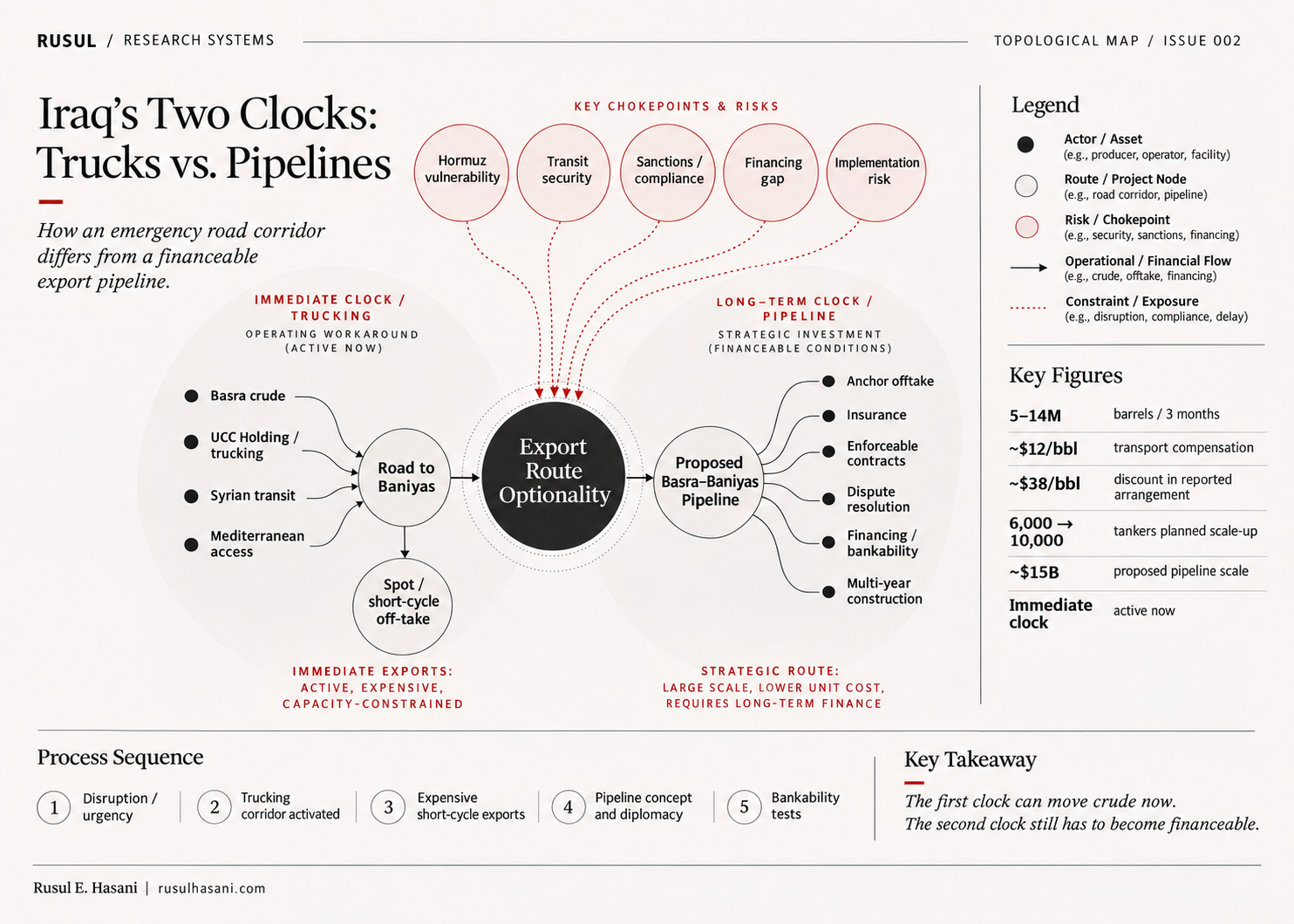
Two days after Barrack’s remarks, Reuters reported that Iraq was already moving crude oil by road to Syria’s Mediterranean coast. The immediate clock was already ticking, while the longer-term infrastructure clock had yet to catch up.
1 | The Route Already Operating
According to Reuters reporting on 13 November, Qatari group UCC Holding began transporting Iraqi crude from the Tuba storage facility near Basra to the Syrian port of Baniyas under an arrangement involving Iraq’s state oil marketer, SOMO.
The operation began on 26 October. Basra Oil Company officials reported movements of approximately 120,000 to 150,000 barrels per day, depending on truck availability. By the time of the report, around 1.6 million barrels had been loaded for transport along the route. The crude travels overland to the Mediterranean, where it can be loaded onto ships for international markets, including destinations in southern Europe. The arrangement is operational, although it faces constraints involving transport capacity, loading facilities and journey times.
Reuters reported that UCC was expanding a fleet of approximately 6,000 trucks towards 10,000.
The economics differ sharply from conventional large-volume pipeline exports. A contract document reviewed by Reuters outlined plans to transport between 5 million and 14 million barrels of heavy crude over three months, with a reported $38-per-barrel sales discount and approximately $12 per barrel allocated to overland transport and transit through Syria. The discount should not be treated entirely as a transportation cost without examining the pricing benchmark and crude-quality adjustments. Nevertheless, the arrangement reveals the commercial trade-off: Iraq and its partners are accepting constrained capacity and potentially substantial margin losses to preserve an alternative export route. Trucking buys time; a pipeline would provide scale.
Source: Reuters, 13 November 2026, Iraq’s Overland Syrian Export Route.
2 | The Pipeline Operating on a Different Clock
The proposed Iraq–Syria pipeline presents a different undertaking. In July 2026, Iraqi and Syrian entities signed memoranda covering the rehabilitation or development of the historic corridor towards Baniyas and the preparation of technical and financial studies. The international consortium named in those arrangements included Chevron, UCC Holding and TI Capital.
The proposed infrastructure would extend Iraq’s ability to move oil towards Mediterranean markets without routing all relevant exports through the Strait of Hormuz. Yet the engineering requirements are substantial. Reuters reported in August that sources familiar with the project expected a system costing at least $15 billion and requiring approximately four years of construction. Much of the historic infrastructure is damaged or unsuitable for the specifications of the proposed system. The project would involve new construction, connections to producing fields, cross-border arrangements and potentially difficult land-access requirements. The reported cost and timeline are estimates, not an approved final investment budget or guaranteed completion schedule.
The consortium’s announced work on feasibility and implementation planning should likewise not be confused with a final investment decision. This distinction matters because a political commitment to an export corridor and the commercial ability to finance that corridor are different achievements. The first can establish a direction. The second requires the project to become sufficiently defined for its costs, revenues, obligations and uncertainties to be evaluated.
Notably, UCC Holding sits across both clocks: operating the immediate trucking corridor while leading the consortium exploring the multi-year pipeline alongside Chevron and TI Capital. Yet moving from a memorandum of understanding to financial close requires solving more than engineering damage. Because the bulk of Iraqi crude flows to Asian refineries rather than Mediterranean buyers, a $15 billion westward corridor must prove not only physical feasibility and cross-border security across Iraq and Syria, but also durable Mediterranean netback economics capable of supporting long-term throughput tariffs.
Sources: Reuters, 17 August 2026; Syrian Arab News Agency, July 2026.
3 | The Question Raised from the Floor
One of the most informative moments in Barrack’s discussion came from the audience.
Former Iraqi electricity minister Dr Luay Al-Khatteeb referred to Nabucco, the European gas pipeline project that had enjoyed substantial international political support but was ultimately not built. His question concerned whether today’s proposed Iraqi export corridors had a credible path towards implementation. The comparison was consequential.
Nabucco did not disappear because policymakers lacked a strategic argument for gas-supply diversification. In 2013, the consortium controlling Azerbaijan’s Shah Deniz II gas selected the Trans-Adriatic Pipeline instead of Nabucco West. The commercial route to market, the competing projects and the choices of the resource holders proved decisive. In response to Al-Khatteeb, Barrack moved from the strategic importance of new corridors to the conditions under which capital might support them.
He referred to offtake, insurance, enforceable arrangements and predictable dispute resolution.These were not peripheral qualifications. They were part of the investment case he was describing. The exchange revealed a distinction already familiar to infrastructure developers.
Strategic demand for a route does not, by itself, establish the commercial demand required to finance that route.
The Iraqi pipeline proposals will be judged partly by how their anticipated volumes, markets, contractual arrangements and construction requirements fit together. Barrack’s remarks identified those concerns. The project documentation will eventually show how they are addressed.
Source: European Commission records on the Nabucco–TAP selection; Thomas Barrack’s Chatham House discussion, approximately 21:00–26:00.
4 | From Veto Points to Bankability: Who Can Commit?
When a representative of the Barzani Foundation questioned whether greater centralisation could threaten Kurdish federal rights, Barrack urged Baghdad and Erbil to resolve their disputes, highlighting the uncertainty such disagreements create for international companies.
For energy investors, the underlying question is more specific: who has the authority to make a commitment, and who can prevent it from being honoured?
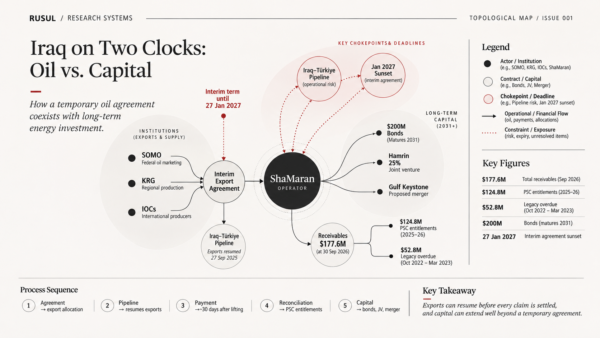
The September 2025 agreement to restart exports through the Iraq–Turkey Pipeline illustrates the distinction. Baghdad, the KRG and international oil producers established a framework that allowed Kurdish crude to reach international markets through SOMO, despite unresolved disputes over oil authority and revenues. The agreement restored operations without settling the underlying institutional conflict.
A proposed Basra–Baniyas pipeline would involve a different set of authorities and commercial parties, but face a related challenge. Iraq and Syria would need enforceable arrangements governing transit access, tariffs, payment obligations, security and liability for interrupted flows. Investors would also require committed crude volumes and credible buyers to justify the substantial upfront capital. These are not administrative details. Each determines who receives revenue, who bears risk and whether a contractual obligation can survive a political disagreement.
Meanwhile, trucking can use existing roads and shorter-term commercial arrangements to move oil immediately, albeit at limited scale and potentially significant cost. Its operational success does not establish the financial viability of a permanent pipeline. Diplomatic engagement may bring the parties together, but it cannot replace contracted volumes, enforceable obligations or a credible financing structure.
The practical test of unity, therefore, is not a shared endorsement of the corridor. It is whether the parties can make commitments that remain effective when their interests diverge.
Conclusion: Two Clocks, One Export Problem
As of 14 November 2026, Iraq is moving crude towards Syria’s Mediterranean coast by road. The proposed pipeline, however, remains a longer-term infrastructure proposition.
The immediate problem is being addressed through commercial logistics. The structural problem remains: securing the volumes, contracts, financing and cross-border obligations needed for a permanent route.
Iraq has demonstrated that it can find another way to move oil. It has yet to demonstrate that the alternative can be built at scale.
Research Notes
- Chatham House, Iraq Initiative Conference, 11 November 2026
- Thomas J. Barrack, The Future of US–Iraq Relations, Chatham House discussion, 11 November 2026, approximately 07:30–12:50 and 18:00–26:15.
- Reuters, 13 November 2026: Iraqi oil exports by road through Syria
- Reuters, 17 August 2026: Iraq–Syria pipeline cost and construction estimates
- SANA, July 2026: Pipeline memoranda and international consortium
- European Union records: Nabucco and the Trans-Adriatic Pipeline