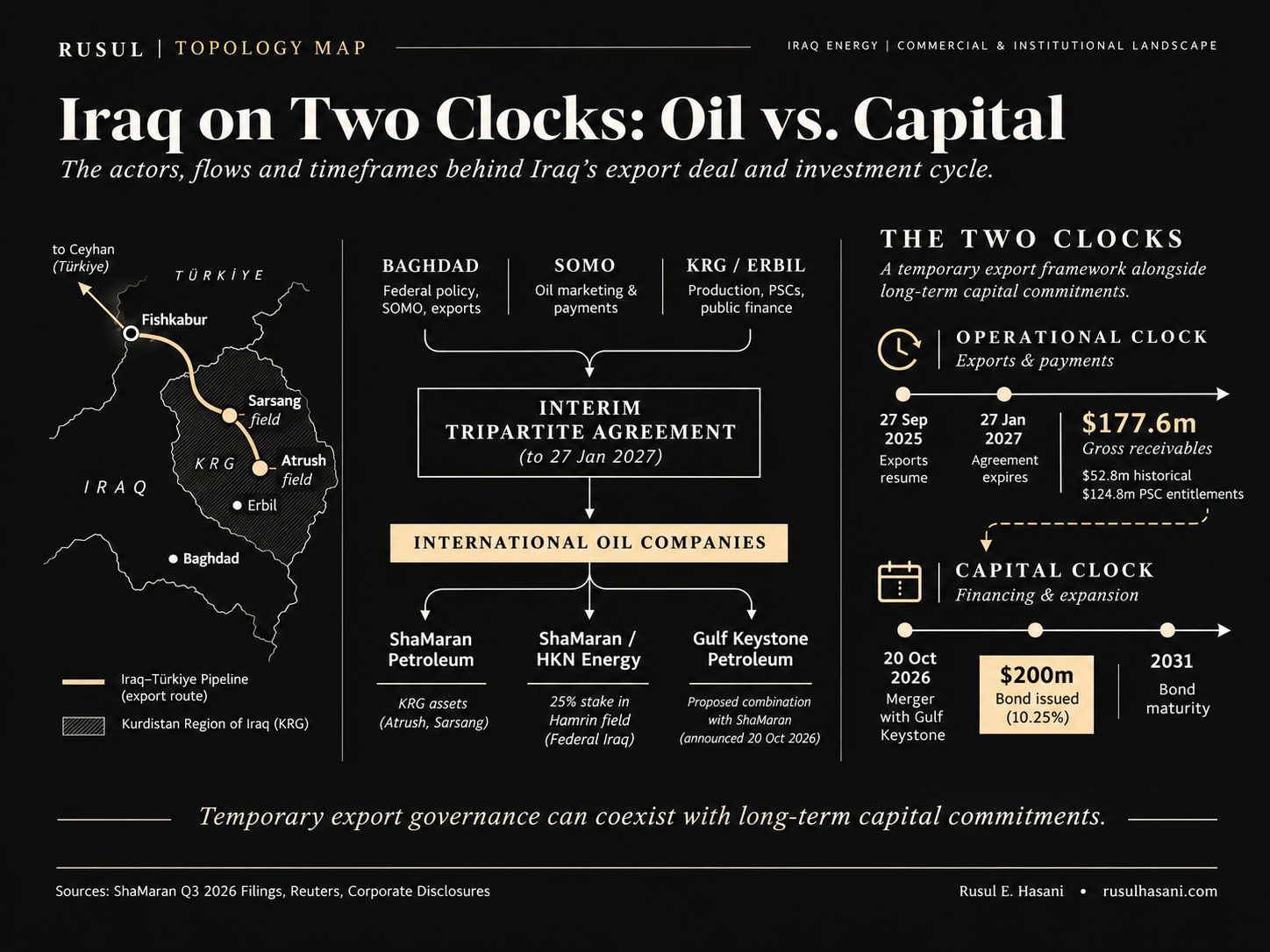
On 11 November 2026, Judge Dr Faiq Zaidan, President of Iraq’s Supreme Judicial Council, addressed Chatham House in London on judicial standards and institutional resilience amid domestic and regional pressures. Two days earlier, ShaMaran Petroleum had published a revealing account of commercial reality in the same country: regular export receipts under an interim oil agreement involving Baghdad, Erbil and international producers, alongside unresolved historical receivables and capital commitments extending well into the next decade.
In October, ShaMaran had placed $200 million in five-year bonds, announced an expansion into Federal Iraq and entered into an agreement to merge with Gulf Keystone Petroleum.
The contrast is worth examining.
An export arrangement extended until January 2027 was operating alongside corporate commitments reaching into 2031 and beyond.
There is no evidence that the company had overlooked this difference in time horizons. Its publicly disclosed financing and expansion decisions suggest a more useful question: How do companies structure long-term business decisions while important elements of their operating environment remain subject to negotiation?
Iraq provides a particularly instructive case because the answer involves more than a company’s balance sheet. It involves federal and regional institutions, oil-marketing arrangements, production-sharing contracts and access to international capital.
1. Why an Existing Pipeline Needed a New Agreement
The Iraq–Türkiye Pipeline was not a newly constructed export route awaiting its first shipment. It was an established piece of infrastructure whose operation had been interrupted since March 2023, following an international arbitration ruling concerning oil exports through Türkiye. Restoring exports required more than making the pipeline physically available. Baghdad, the Kurdistan Regional Government (KRG) and international oil companies had to establish an arrangement under which oil could be exported, marketed and paid for.
The parties entered those negotiations from different institutional and contractual positions. The federal government maintained its role in the national marketing of crude through the State Organization for Marketing of Oil (SOMO). The KRG was responsible for an established regional production sector and had contractual relationships with international producers. It also faced public-finance pressures, including disputes concerning budget transfers and public-sector salaries.
The international oil companies needed an acceptable arrangement for recovering production costs and receiving their contractual entitlements. These were not identical interests. Nor does the public record establish the full negotiating calculations of each party. What it does show is the gradual construction of a workable arrangement.
In August 2025, the KRG Ministry of Natural Resources reported that federal and regional technical teams had agreed on an export mechanism following joint meetings and field visits. The arrangement allocated 50,000 barrels per day for domestic use in the Kurdistan Region, with the remainder transferred to SOMO for export.
In September, the three parties reached the agreement that enabled pipeline exports to resume on 27 September 2025. The outcome was commercially significant: crude that had been unable to reach international markets through the pipeline could move again. But the significance extended beyond transportation. The parties had established a set of operational and financial procedures through which different institutional responsibilities could function together.
The agreement did not require every underlying dispute to be resolved before exports restarted. That distinction helps explain both its usefulness and its temporary character.
Sources: KRG Ministry of Natural Resources, August 2025; Reuters, September 2025.
2. How the Arrangement Turned Oil into Payments
Under the interim tripartite agreement, participating oil companies are compensated through allocations of crude oil.
SOMO allocates payment barrels to a marketing company appointed by the international producers. The allocated cargoes are sold, and companies generally receive the proceeds approximately 30 days after each lifting. This mechanism has produced observable results.
In its November 2026 report, ShaMaran stated that payments under the interim arrangement had arrived regularly since international exports resumed in September 2025. The same report also described the continuing reconciliation of contractual entitlements under the companies’ production-sharing contracts (PSCs). Those two developments need to be read together.
At 30 September 2026, ShaMaran recorded approximately $177.6 million in gross oil-sales receivables. Of this amount:
- $52.8 million concerned oil delivered to the KRG between October 2022 and March 2023. The company classified these as historical overdue receivables.
- $124.8 million concerned remaining PSC entitlements associated with exports through the Iraq–Türkiye Pipeline during 2025–2026.
The distinction is important.
The first category concerns amounts overdue from an earlier period. The second concerns contractual entitlements undergoing reconciliation within the more recent export framework. They should not be treated as a single amount of missed payments under the current agreement. An appointed international consulting firm has been reviewing producer invoices against the relevant PSCs. Following the initial review, supplementary payments began in October 2026 through allocations of additional oil cargoes.
ShaMaran reported receiving $26.7 million in combined oil-sales proceeds and supplementary payments after the end of the third quarter.
The arrangement therefore appears to be doing two jobs at different stages.
It has restored a functioning process for ongoing exports and payments. In parallel, the parties are working through the settlement of contractual entitlements that cannot be established solely from the regular payment cycle.
The company has also disclosed that, compared with its historical KRG receivables, it considers counterparty exposure under the newer arrangements more diversified, with contractual recourse involving the KRG and/or SOMO in circumstances of non-payment.
This is evidence of a negotiated payment structure, not simply a promise to pay.
It does not establish that every claim will ultimately be recovered. But neither does it support treating the outstanding entitlements as evidence that the current mechanism has failed.
Source: ShaMaran, Q3 2026 financial disclosures, Note 12.
3. A Temporary Agreement, Longer-Term Capital
The interim tripartite agreement has been extended until 27 January 2027.
A longer-term arrangement is expected following the reconciliation of the producers’ invoices and contractual entitlements. Meanwhile, ShaMaran’s corporate decisions have moved on a different timetable. On 21 October 2026, the company announced the placement of $200 million in five-year senior unsecured bonds, carrying an annual coupon of 10.25% and maturing in 2031. The proceeds were intended to refinance an existing bond maturing in 2029, with a 12% coupon, and to support investment in the Hamrin field in Federal Iraq and general corporate purposes. The new bond was settled on 5 November 2026. The previous day’s financing decision was accompanied by changes to the company’s asset portfolio.
On 20 October, ShaMaran announced an extension of its cooperation with HKN Energy into Federal Iraq. Through the transaction, ShaMaran acquired a 25% shareholding in the joint venture holding the Hamrin development and production contract. The transaction closed on 9 November.
On the same date in October, ShaMaran also announced an agreement to combine its business with Gulf Keystone Petroleum. The proposed merger, subject to shareholder approvals and other conditions, was expected to complete in mid-2027. The companies presented the combination as an opportunity to create a larger producer with assets across the Kurdistan Region and Federal Iraq, greater scale, a broader portfolio and improved access to financing.
These decisions matter because they show what the company was actually doing while the interim export arrangement remained in force. It was not merely waiting for every institutional uncertainty to be resolved. It was refinancing debt, expanding its asset base and pursuing corporate consolidation.
The disclosed rationale emphasised refinancing, portfolio diversification, production potential and scale.It would be speculative to claim that the interim export agreement caused these decisions. It would be equally speculative to assume that the company regarded the agreement as risk-free.
The more defensible observation is that the company was making longer-term commitments while continuing to operate within a negotiated, time-limited export framework.
What remains to be established is how that framework featured in the company’s financing assumptions and commercial assessment. The bond terms, transaction documents and management disclosures provide a starting point. They do not, on their own, reveal every assumption used by lenders, investors or the company’s board.
Even without access to internal board models, two commercial signals stand out from the public filings. First, refinancing a 12 per cent bond maturing in 2029 with a 10.25 per cent facility maturing in 2031 indicates that credit markets priced the combination of restored export cash flows and broader asset scale as net credit-enhancing, despite the interim agreement’s January 2027 sunset clause. Second, acquiring a 25 per cent stake in the Hamrin field in Federal Iraq while pursuing a merger with Gulf Keystone suggests that ShaMaran was not merely enduring the KRG–SOMO export bottleneck—it was actively hedging against it by diversifying into federal jurisdictions and larger reserve scale.
Sources: ShaMaran bond announcement, 21 October 2026; ShaMaran–Gulf Keystone merger announcement; ShaMaran Q3 2026 Results.
4. Sequenced Coordination: Why the Two Clocks Coexist
Viewed from the positions of its participants, the interim framework reflects a pragmatic division of functions rather than a comprehensive political settlement. For Baghdad, it brings Kurdistan’s crude exports within a SOMO-linked marketing channel; for Erbil, it restores export revenues tied to wider budget and salary negotiations; and for producers, it generates predictable cash receipts while legacy claims undergo formal audit.
What makes the arrangement analytically distinctive is sequenced institutional coordination. Operational exports resumed first, invoice reconciliation ran in parallel, and negotiations over a permanent framework remained open. Two distinct timelines therefore emerged: a short-term institutional clock governing export continuity until January 2027, and a multi-year corporate clock governing debt maturities through 2031 and field development beyond it.
These timelines are linked—export proceeds underpin corporate liquidity—but they are not identical. An agreement can be temporary without being commercially dysfunctional, and a company can commit long-term capital without assuming that every regulatory variable is permanently settled. The remaining empirical question for researchers is narrower than a blanket country-risk rating: how precisely did management and bondholders weight the interim export mechanism against asset diversification when pricing these commitments?
5. Analytical Implications for Energy Risk Assessment
The broader lesson of the Iraqi case is that sovereign and regulatory risk in energy infrastructure rarely operates as a single binary switch. Treating institutional uncertainty as an undifferentiated country-risk discount obscures how capital actually navigates fragmented jurisdictions.
To assess energy investments in similar operating environments, analysts and investment committees must disaggregate three separate variables:
Payment mechanics versus legacy arrears: Distinguish between whether a current mechanism reliably converts production into cash (the 30-day lifting cycle) and how historical disputes ($52.8 million in pre-2023 receivables) are quarantined for separate reconciliation.
Contractual recourse versus political headlines: Evaluate whether revised commercial structures diversify counterparty exposure (such as dual KRG/SOMO recourse) rather than relying on sweeping assumptions about state stability.
Operational horizon versus capital-structure horizon: Examine how companies use liability management, scale, and multi-jurisdictional asset portfolios to bridge the gap between short-term regulatory renewals and multi-year investment cycles.
Conclusion
Between September 2025 and November 2026, Baghdad, Erbil and international producers demonstrated that export continuity and commercial capital allocation can proceed even while foundational legal and fiscal questions remain under negotiation. ShaMaran’s regular export receipts, ongoing PSC reconciliations, 2031 bond refinancing and expansion into Federal Iraq neither prove that Iraq’s institutional risks have disappeared nor validate treating the interim agreement as fragile window-dressing. Rather, they show that commercial durability in contested energy markets depends on how well institutional mechanisms and corporate balance sheets are engineered to operate across different clocks.
Research Notes
Judicial and institutional context
- Iraqi Supreme Judicial Council: Faiq Zaidan at Chatham House, 11 November 2026
- Chatham House: Iraq Initiative Conference 2026
Oil-export negotiations and arrangements
- KRG Ministry of Natural Resources: Oil Export Mechanism, August 2025
- KRG Ministry of Natural Resources: Statement, 24 September 2025
- Reuters: Agreement to Resume Kurdistan Oil Exports, 25 September 2025
Company disclosures and financial evidence