Executive Briefing
Iraq’s proposed merger of the oil and electricity ministries raises a question of institutional design: whether consolidating ministerial authority can improve the physical and commercial performance of the energy system. Iraq established an integrated energy strategy in 2013, yet its National Development Plan 2024–2028 continues to identify inadequate integration as a structural challenge. The decisive test lies in the allocation of fuel, delivery obligations, operational authority and financial liability across the fuel-to-power chain. Before restructuring its cabinet, Baghdad needs to quantify the generation losses attributable to institutional fragmentation and establish whether consolidation would recover capacity, reduce fiscal exposure or improve investment bankability. [2][3][8]
Central Questions
01 How Can an Oil-Sector Disruption Become an Electricity Failure?
02 Did Iraq Already Design an Integrated Energy System?
03 Where Does Accountability Break in the Fuel-to-Power Chain?
04 What Do Pakistan, Norway, and Egypt Show About Ministry Mergers?
05 What Is the Strongest Case Against a Ministry Merger?
06 What Evidence Should Decide Whether Iraq Merges the Ministries?
01 | How Can an Oil-Sector Disruption Become an Electricity Failure?
In March 2007, a grid failure interrupted electricity supply to Iraq’s Baiji refinery, reducing its output of refined fuel. The US Government Accountability Office documented the incident during its assessment of post-war reconstruction. The episode exposed a reciprocal dependency embedded in Iraq’s energy infrastructure: electricity generation depends on petroleum products and natural gas, while their extraction, processing and refining depend on electricity. Disruption in either sector can propagate through the other, creating a feedback loop in which the loss of electricity constrains the production of the fuel required to restore it. [1]
The same assessment identified inadequate coordination over fuel type and availability as a contributor to generation interruptions and increased maintenance costs. Although documented in 2007, the underlying mechanism remains relevant to contemporary investment decisions. The economic performance of a generating asset depends on infrastructure and operational commitments extending beyond its contractual boundaries. Where those dependencies are inadequately governed, a completed asset may remain exposed to failures elsewhere in the energy system. [1]
02 | Did Iraq Already Design an Integrated Energy System?
The institutional proposition predates the current merger discussions. In 2017, a former electricity minister proposed a federal energy ministry encompassing oil, electricity, and industry and minerals, alongside a federal energy council and a separation between policy-making and corporate operations. Preliminary discussions reported in November 2026 describe a narrower institutional configuration. The available evidence establishes a policy discussion rather than an enacted restructuring programme. [4][5][6]
A more consequential precedent emerged in 2013. Developed with Booz & Company and Iraqi government participation, the Integrated National Energy Strategy recognised the interdependence of petroleum, gas, electricity and energy-intensive industries. Its institutional architecture included differentiated policy, regulatory and operational responsibilities, supported by steering and programme-management mechanisms intended to align investment schedules and resolve cross-sector disputes. [2]
More than a decade later, the National Development Plan 2024–2028 continued to identify inadequate integrated energy management, fuel mismatch, contracting weaknesses and revenue collection as sectoral challenges. This continuity warrants an institutional implementation audit: which coordination powers established or proposed under the 2013 strategy became operational, which remain enforceable, and which require additional authority? The answer determines whether Iraq needs a new institutional architecture or the effective implementation of an existing one. [3]
03 | Where Does Accountability Break in the Fuel-to-Power Chain?
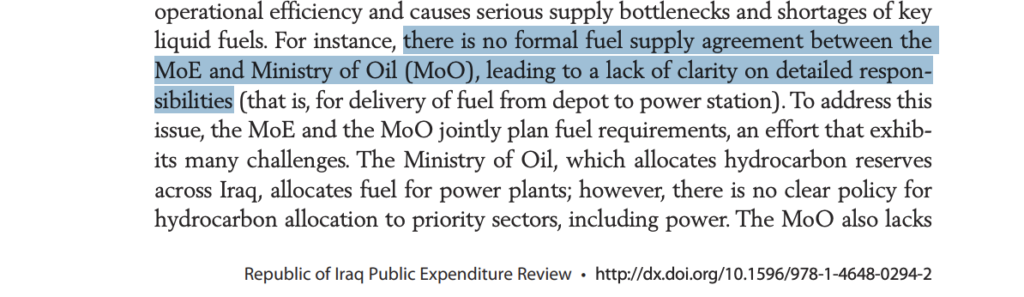
The critical interface sits between fuel allocation and electricity generation. A World Bank public expenditure review documented the historical absence of a formal fuel-supply agreement between Iraq’s oil and electricity ministries, leaving responsibilities, including transportation from fuel depots to generating facilities, insufficiently defined. Whether this contractual gap persists in 2026 requires verification. Its historical significance lies in exposing a category of institutional risk that can survive administrative restructuring. [8]
At plant level, the relevant variables include contracted fuel quantities, nominations, delivery pressure, calorific specifications, custody-transfer points and outage schedules. At commercial level, the corresponding exposures concern alternative supply arrangements, commissioning delays, performance testing, contractual relief and generation losses. Where these obligations remain unresolved, the state may retain risks that are neither adequately priced in procurement nor assigned to an accountable counterparty. The resulting exposure extends into public finances through fuel subsidies, arrears and domestic pricing arrangements. [9]
In July 2026, Iraq’s electricity minister reported to parliament that available generation had declined from approximately 27,000 MW to 22,000 MW, citing fuel disruption and unavailable generating units among the contributing factors. The reported reduction of approximately 5 GW, equivalent to 18.5 per cent of the initial figure, provides a measurable starting point for institutional analysis. The proportion attributable specifically to coordination failure remains undetermined. Establishing that proportion is essential to estimating the operational value of a ministerial merger. [10]
04 | What Do Pakistan, Norway, and Egypt Show About Ministry Mergers?
Pakistan consolidated petroleum and power under a Ministry of Energy in 2017 while retaining specialised divisions. By March 2024, the IMF reported approximately PKR 2.8 trillion in power-sector circular debt, alongside approximately PKR 2.1 trillion in gas-sector arrears recorded in January 2024. These liabilities reflect persistent challenges involving tariff recovery, system losses, collections and delayed payments. Pakistan illustrates the limits of administrative consolidation when the commercial settlement mechanisms connecting energy institutions remain financially impaired. [11][12]
Norway provides an alternative institutional configuration. A common Ministry of Energy operates alongside specialised institutions, including the Norwegian Offshore Directorate, the Norwegian Water Resources and Energy Directorate and the transmission system operator Statnett. This arrangement demonstrates how strategic authority can coexist with differentiated technical and operational mandates. Norway’s hydropower-dominated electricity system and petroleum-export profile, however, limit direct comparisons with Iraq’s physical energy balance. [13]
Egypt retained separate petroleum and electricity ministries during its June 2024 electricity shortages. Joint ministerial action and additional fuel procurement preceded the prime minister’s July announcement that summer load-shedding would be suspended, within a reported LNG import programme covering 21 cargoes. The episode demonstrates that operational coordination can be strengthened without ministerial consolidation, provided that procurement authority, financing and physical fuel availability support the intervention. [15][16]
The three cases expose different dimensions of institutional performance: financial settlement in Pakistan, functional specialisation in Norway and operational coordination in Egypt. Their relevance to Iraq lies in the design of decision rights, commercial obligations and escalation mechanisms rather than the number of ministries responsible for energy.
05 | What Is the Strongest Case Against a Ministry Merger?
Functional specialisation offers a credible alternative to administrative consolidation. During an online seminar attended by the author, a former Iraqi oil-sector practitioner argued for improving the performance of existing institutions, drawing on the specialisation of Saudi Aramco and SABIC and the architecture of distributed engineering systems. The intervention provides a practitioner’s perspective on institutional design [7]
Aramco’s acquisition of a 70 per cent stake in SABIC in 2020 illustrates how strategic ownership can coexist with specialised corporate operations. Distributed engineering systems similarly rely on clearly specified interfaces and differentiated responsibilities to limit coordination bottlenecks. Applied to public administration, the principle suggests that operational autonomy can be preserved where interdependencies are governed by enforceable obligations and effective escalation mechanisms. [17][18]
The case for consolidation remains strongest where divided ministerial authority prevents timely fuel allocation, infrastructure sequencing or investment decisions. Its effectiveness therefore depends on identifying the binding constraint: fragmented authority, inadequate enforcement, information asymmetry, physical scarcity or insufficient financing. Each represents a distinct failure mechanism requiring a corresponding institutional remedy.
06 | What Evidence Should Decide Whether Iraq Merges the Ministries?
Iraq should evaluate three institutional configurations against the same operational evidence:
- Unified Ministry: A single Ministry of Energy with specialised entities responsible for oil, gas and electricity operations.
- Separate Ministries with Stronger Oversight: Retain both ministries while strengthening technical supervision and cross-sector coordination.
- Contract-Based Coordination: Keep both ministries independent but connect them through enforceable fuel-supply agreements, clear responsibilities and binding joint decisions.
A plant-level audit should examine the entire fuel-to-power chain, from fuel requirements and delivery to electricity dispatch, payment and dispute resolution،it should distinguish actual fuel shortages and equipment failures from preventable delays caused by conflicting instructions, unclear contractual responsibilities or ineffective decision-making. Each proposed reform should then be assessed against three practical outcomes:
- For the state: Clear accountability for fuel allocation and public spending.
- For lenders: Greater certainty over fuel supply continuity and the financial risks of interruptions.
- For EPC contractors: Clear responsibility for delays in commissioning, performance testing and final acceptance, including who bears the associated costs. [9]
Net Assessment
Iraq’s energy reform should be evaluated through its capacity to govern interdependencies across petroleum, gas, electricity and public finance. The 2013 Integrated National Energy Strategy established an institutional precedent for this approach, while the National Development Plan 2024–2028 indicates that integration remains an unresolved policy challenge. A ministerial merger would acquire strategic value where it demonstrably resolves competing decision rights, strengthens enforceable commitments and reduces exposure across the fuel-to-power chain. [2][3]
The decisive performance indicator is recoverable generation attributable to institutional reform, supported by a measurable reduction in interruption risk, contractual uncertainty and fiscal exposure. Until that relationship is established, the economic value of administrative consolidation remains unquantified.
Sources & Evidence
[1] US Government Accountability Office (2007) | Rebuilding Iraq: Integrated Strategic Plan Needed to Help Restore Iraq’s Oil and Electricity Sectors Source
[2] Middle East Economic Survey (2013) | Iraq’s Integrated National Energy Strategy: Investment and Institutional Requirements Source
[3] Iraq Ministry of Planning | National Development Plan 2024–2028 Source
[4] Luay al-Khatteeb (2017) | Establishing an Energy Ministry and Federal Energy Council Source
[5] Middle East Economic Survey (15 May 2020) | On Iraq, Power and Power Politics: MEES Interview with Luay al-Khatteeb Source
[6] Shafaq News (16 November 2026) | Baghdad Considers Merging Oil and Electricity Ministries Source
[7] Managing Iraq’s Oil Wealth (12 November 2026) | Online lecture attended by the author.
[8] World Bank | Republic of Iraq: Public Expenditure Review, Toward More Efficient Spending for Better Service Delivery Source
[9] International Monetary Fund (2023) | The Fiscal Cost of Iraq’s Electricity Sector Source
[10] Iraqi Council of Representatives (27 July 2026) | Parliamentary Discussion of the Electricity Crisis Source
[11] Pakistan Ministry of Energy | Power Division Yearbook 2022–2023 Source
[12] International Monetary Fund (2024) | Pakistan: 2024 Article IV Consultation Source
[13] Norwegian Government | Energy: Government Policy and Institutional Responsibilities Source
[14] US Energy Information Administration | Iraq Country Analysis Source
[15] Cairo Governorate (25 June 2024) | Joint Statement on Electricity Load-Shedding Source
[16] Reuters (17 July 2024) | Egypt Will Halt Load-Shedding Power Cuts from Sunday, PM Says Source
[17] SABIC (June 2020) | SABIC Announces Completion of Saudi Aramco’s Acquisition of PIF Stake Source
[18] Microsoft Azure Architecture Center | Minimize Coordination: Distributed Systems Design Principles Source
3 Comments
test
sss
tet